
Nervous System Regulation: A Guide to Healing from the Ground Up
Nervous System Regulation: A Guide to Healing from the Ground Up

True regulation starts not in the mind, but in the body.
Most people who come to personal development have already tried everything that lives above the neck. The affirmations. The mindset work. The journalling. The vision boards. And yet something keeps resetting. The same patterns return. The same emotional charge re-emerges. The same ceiling appears.
The reason is almost always the same: the nervous system has been left out of the equation.
This guide is about what nervous system regulation actually is, why it sits at the foundation of all lasting personal change, and what it practically looks like to work with it rather than around it. This is bottom-up healing. And it changes everything.
Quick answer: Nervous system regulation is the body's ability to move fluidly between states of activation and calm, responding appropriately to life's demands without getting stuck in survival mode.
What Is Nervous System Regulation? A Clear Definition
Nervous system regulation refers to the capacity of the autonomic nervous system (ANS) to shift between different physiological states in response to the environment and then return to a baseline of safety and calm.
In a regulated nervous system, you can move into activation when needed to meet a deadline, navigate a difficult conversation, or respond to genuine danger and then come back down. You do not get stuck at the top or bottom of the dial.
In a dysregulated nervous system, this fluidity breaks down. You may find yourself chronically activated (anxious, reactive, hypervigilant) or chronically shut down (numb, flat, disconnected, unmotivated). Often people oscillate between both.
The autonomic nervous system: a simple breakdown
The ANS has two main branches that most people have heard of, and a third that is increasingly recognised as central to regulation:
•The sympathetic nervous system (the accelerator). Drives fight-or-flight responses. Prepares the body for action.
•The parasympathetic nervous system (the brake). Drives rest, digest, and recovery. Brings you back to baseline.
•The vagus nerve, the longest cranial nerve in the body, central to the parasympathetic branch, and the primary pathway through which regulation or dysregulation is expressed.
Source: National Library of Medicine (US) Anatomy, Autonomic Nervous System
Polyvagal Theory and why it matters
Developed by neuroscientist Dr Stephen Porges, Polyvagal Theory offers a more nuanced map of the nervous system. Rather than a simple two-state model, it describes three distinct states:
Ventral vagal (safe and social) the regulated baseline. Connected, curious, open, creative.
Sympathetic activation (fight or flight) mobilised. Anxious, reactive, driven by perceived threat.
Dorsal vagal shutdown (freeze or collapse) immobilised. Numb, dissociated, low energy, withdrawn.
Most people seeking support with personal development, emotional patterns, or self-belief are cycling between sympathetic activation and dorsal shutdown. The work of regulation is learning to return to ventral vagal to the state from which growth, connection, and change actually become possible.
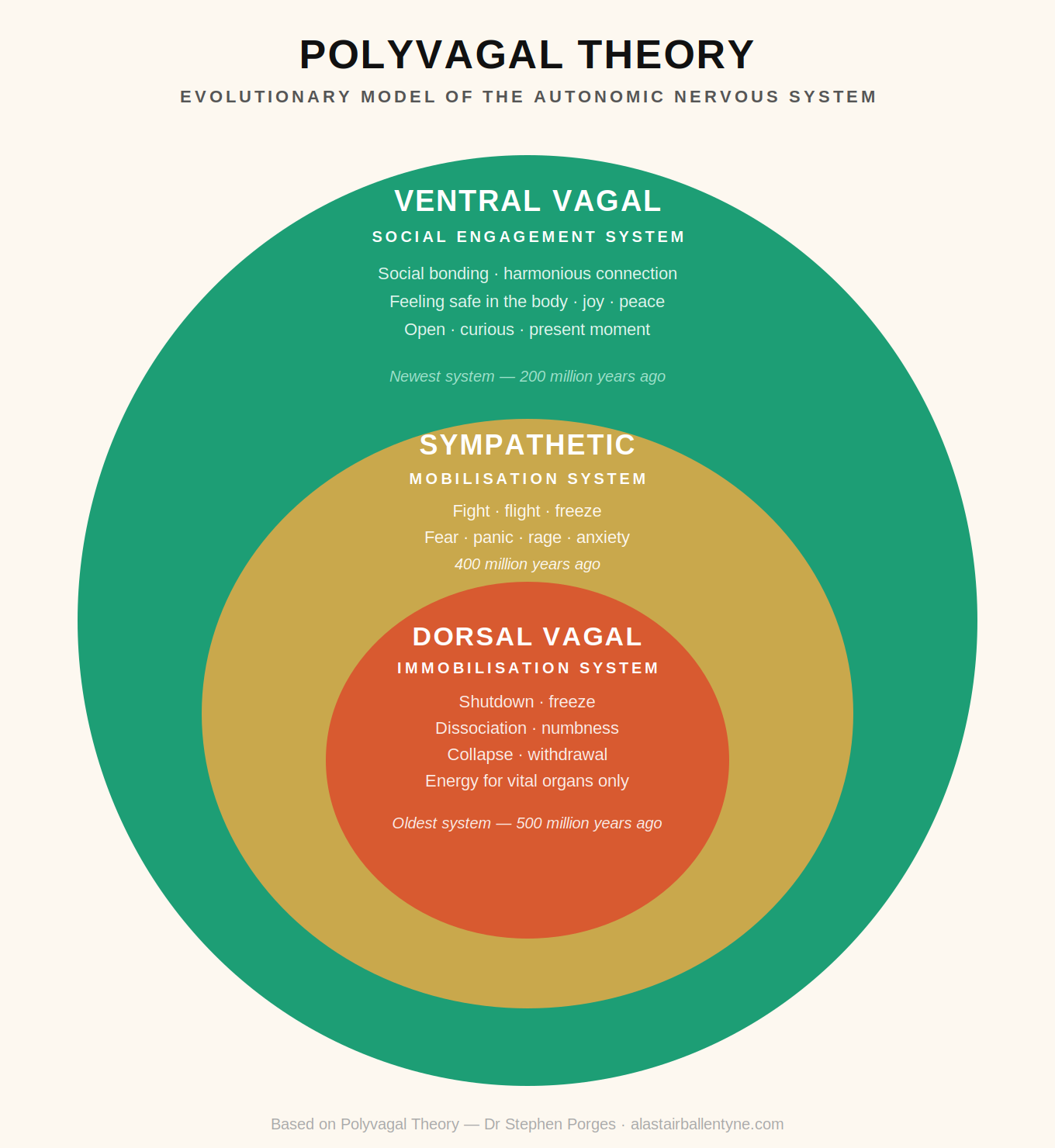
Understanding which state you are in is the first step towards regulation.
What Does a Dysregulated Nervous System Feel Like?
Dysregulation is not a character flaw. It is a physiological state. The body has learned, through repeated experience, that the world is not safe enough to fully relax. This learning often begins early in life and becomes the nervous system's default setting.
Key insight: What looks like a mindset problem is often a nervous system problem. Beliefs are stored not just in thoughts but in the body's physiology.
Signs of a chronically dysregulated nervous system
You may recognise some of these patterns:
Persistent anxiety or a sense that something bad is about to happen
Difficulty relaxing even when nothing is wrong
Feeling emotionally numb, flat, or disconnected from life
Reacting disproportionately to small stressors
Chronic fatigue that sleep does not resolve
Digestive issues, muscle tension, or unexplained physical symptoms
Difficulty with concentration, motivation, or completing tasks
Feeling stuck in repetitive emotional or behavioural patterns despite wanting to change
A persistent inner critic that feels impossible to quieten
Swinging between periods of high drive and complete crash
Source: Van der Kolk B. The Body Keeps the Score: Brain, Mind, and Body in the Healing of Trauma (2014)
What does burnout do to your nervous system?
Burnout is not simply tiredness. It is a nervous system collapse. The body has been running in sympathetic overdrive for so long that the dorsal vagal brake kicks in as a protective shutdown. Some hallmarks of burnout are emotional flatness, inability to feel pleasure, complete depletion are physiological responses, not psychological weakness.
Recovery from burnout is not about pushing harder or reframing your thoughts. It requires working directly with the nervous system to create genuine safety in the body.
Source: World Health Organization: Burn-out an 'occupational phenomenon' (2019)

Burnout is a physiological state, not a personal failure.
Why Mindset Work Alone Is Not Enough
Personal development has a problem. The vast majority of its tools and frameworks live in the top-down part of the brain the prefrontal cortex, the thinking mind, the part that reasons, reframes, and sets intentions. Affirmations. Cognitive reframing. Goal setting. Visualisation.
These tools have genuine value. But they have a ceiling.
That ceiling is the nervous system.
Top-down versus bottom-up processing
Top-down processing moves from thought to body. You think something, and the thought influences how you feel. Most conventional personal development works this way.
Bottom-up processing moves from body to thought. Your physiological state - what your nervous system is doing right now shapes what thoughts are available to you, what beliefs feel true, what futures feel possible.
When someone is in sympathetic activation, the prefrontal cortex quite literally goes partially offline. The rational, visionary, growth-oriented mind becomes harder to access. Telling someone in that state to 'believe in themselves more' is like trying to have a philosophical conversation with someone who is running from a fire.
The bottom-up principle: You cannot think your way into a regulated state. You have to feel and move your way there first. Then the thoughts change naturally.
Source: Ogden P, Minton K, Pain C. Trauma and the Body: A Sensorimotor Approach to Psychotherapy (2006)
What happens when you skip nervous system work
You get temporary results that do not stick. You may have noticed this yourself. A powerful workshop that fades within weeks. Insights that feel profound in the moment but do not translate into lasting change. Patterns that return despite your best efforts.
This is not because you are doing it wrong. It is because insight without somatic integration does not create lasting change. The body needs to be included in the process.
How to Heal a Chronically Dysregulated Nervous System: A Practical Guide

Simple somatic practices can begin to shift chronic dysregulation within days.
Healing a chronically dysregulated nervous system is not about finding the right technique and doing it once. It is about consistent, gentle practice that accumulates over time. The nervous system learns through repetition and safety not through force.
1. Learn to notice your state before trying to change it
The first skill is awareness. Most people are so habituated to their dysregulated baseline that they no longer notice they are in it. Beginning to notice 'I am activated right now' or 'I am in shutdown' creates a small but crucial gap between stimulus and response. That gap is where choice lives.
2. Use the breath as a direct regulator
The breath is the one function of the autonomic nervous system that can be consciously controlled, making it the most accessible regulation tool available. Specifically, extending the exhale longer than the inhale activates the parasympathetic branch and directly stimulates the vagus nerve.
•Try a 4-count inhale through the nose and 8-count exhale through the mouth
•Even 5 minutes of extended exhale breathing produces measurable physiological change
•Box breathing (4 counts in, 4 hold, 4 out, 4 hold) is effective for sympathetic activation
3. Engage the vagus nerve directly
Vagal tone the resilience and responsiveness of the vagus nerve can be actively developed. Higher vagal tone correlates directly with greater nervous system flexibility and emotional regulation capacity.
Humming, singing, or chanting (vibration in the throat stimulates the vagus nerve)
Cold water on the face or a cold shower (activates the dive reflex, stimulating vagal tone)
Gargling with water for 30 seconds at a time
Slow, rhythmic movement such as walking, gentle yoga, or swaying
4. Titrate rather than flood
A common mistake in nervous system work is to try to process everything at once. The nervous system does not work that way. It heals in small doses of manageable activation followed by return to safety a process called titration.
Think of it as building capacity rather than emptying a tank. Each time you move into slight activation and return to calm, your window of tolerance expands a little. Over time, things that used to dysregulate you significantly begin to register as manageable.
5. Address the body's stored patterns directly
Some dysregulation is not resolved by breathing and movement alone. It is held in the body as patterns linked to past experience emotional memories that the nervous system has encoded as ongoing threats. This is where body-based therapeutic approaches become essential.
Techniques such as Emotional Freedom Technique (EFT tapping) work precisely at this level. By stimulating acupressure points while attending to the emotional charge of a memory or pattern, EFT creates a dual process that allows the nervous system to update its threat response without having to relive the original experience at full intensity.

EFT tapping works directly at the intersection of the nervous system and emotional memory.
The Role of Emotional Memory in Nervous System Dysregulation
The nervous system does not just respond to what is happening now. It responds to what it predicts will happen, based on everything that has happened before. This predictive processing is extraordinarily efficient and it is also the mechanism behind chronic dysregulation.
How the body stores emotional experience
When we have an overwhelming or threatening experience, particularly in childhood when the nervous system is still developing, the memory of that experience becomes encoded not just cognitively but physiologically. The body stores the felt sense of the event- the tension, the contraction, the activation pattern as an implicit memory.
Later in life, when something resembles that original experience, even subtly, even unconsciously the nervous system re-activates the same pattern. This is not irrational. It is extraordinarily rational from a survival perspective. The problem is that it operates on an outdated map.
The key principle: The nervous system is not responding to what is happening. It is responding to what it learned happened before. Updating that learning requires working at the level where it is stored: in the body.
Why understanding this changes everything
When you understand that your nervous system is operating from a survival script written by past experience, you stop fighting your reactions as character flaws and start working with them as information. The seemingly ever-present anxiety, the shutdown, the self-sabotage, these are not evidence of being broken. They are evidence of a nervous system doing exactly what it was trained to do.
The question then becomes not 'what is wrong with me?' but 'what did my nervous system learn, and is that learning still accurate?'
That reframe opens the door to genuine change.
Nervous System Regulation and Personal Development: The Missing Link

Regulation is not the destination. It is the foundation from which everything else becomes possible.
Lasting personal development requires a regulated nervous system as its foundation. Not because the other work is valueless, but because without regulation, the other work cannot fully land.
What becomes possible in a regulated state
When the nervous system is in its ventral vagal state - safe, social, connected a remarkable range of capacities come online:
The prefrontal cortex is fully accessible, meaning clear thinking, perspective-taking, and genuine choice become available
Emotional experiences can be felt and processed rather than suppressed or overwhelmed
New information can be genuinely integrated rather than filtered through a threat lens
Connection with others feels safe and rewarding rather than threatening
Creative thinking, imagination, and visioning become possible
Change feels genuinely available rather than intellectually understood but emotionally out of reach
The sequence that actually works
The sequence for lasting change is not: think differently, then feel differently, then be different.
The sequence that actually works is: regulate the nervous system, then process the emotional experience held in the body, then update the belief that was formed from that experience, then build new patterns from a genuinely different physiological foundation.
This is what bottom-up healing looks like in practice. And it is the opposite of what most personal development frameworks teach.
Nervous System Regulation Techniques: An Overview
EFT tapping addresses the link between emotional memory and nervous system activation
Somatic Experiencing developed by Peter Levine, works with incomplete stress responses held in the body
Sensorimotor psychotherapy integrates movement and body awareness into trauma resolution
Yoga and breathwork particularly slow, parasympathetic-activating practices
EMDR uses bilateral stimulation to process traumatic memory and reduce nervous system charge
Self-regulation practices for daily life
Extended exhale breathing (see Section 4 above)
Cold water exposure face, hands, or full shower
Humming, singing, toning
Slow rhythmic movement walking, swaying, gentle stretching
Orienting slowly turning the head to take in the environment, signalling safety to the nervous system
Safe touch hand on heart, self-holding, or connection with a trusted person or animal
Nature exposure research consistently shows time in natural environments reduces cortisol and activates the parasympathetic branch
What is nervous system regulation therapy?
Nervous system regulation therapy refers to any therapeutic modality that works directly with the physiological state of the nervous system rather than relying solely on cognitive or verbal processing. This includes approaches such as:
Somatic Experiencing
EFT and Clinical EFT
EMDR
Sensorimotor Psychotherapy
Trauma-Sensitive Yoga
Polyvagal-informed therapy
The common thread is that all of these modalities work at the level of the body's felt experience, not just the narrative about that experience.

Body-based therapeutic approaches work where talk therapy has a natural ceiling.
How Long Does It Take to Repair a Dysregulated Nervous System?
This is one of the most common questions, and the honest answer is: it depends.
For mild or recent dysregulation, consistent daily practices over 4 to 8 weeks can produce noticeable and lasting shifts. For chronic or developmental dysregulation patterns that have been present since childhood the timeline is longer, and working with a skilled practitioner typically accelerates results significantly.
What research and clinical experience consistently show is that the nervous system is plastic. It can change. The same neurological mechanisms that embedded old patterns can create new ones. The process requires consistency, patience, and crucially the right kind of support.
Important note:Trying to rush nervous system healing often backfires. The system responds to safety and patience, not urgency and force. Gentle, consistent practice creates more durable change than intense periodic effort.
Source: Levine PA. In an Unspoken Voice: How the Body Releases Trauma and Restores Goodness (2010)
