When Behaviour Change Programmes Replace Emotional Education
TL;DR: The UK government's £20 million strategy to halve violence against women and girls relies on behaviour modification programmes, but these approaches risk creating compliance without transformation. Without emotional literacy—teaching young people to recognise, name and regulate emotions as energy—these initiatives may become tick-box exercises that suppress behaviours without addressing root causes. Effective violence prevention requires embodied practices like EFT tapping, restorative approaches that invite rather than exclude, and tools that help people recognise emotional manipulation in online spaces.
Can behaviour modification prevent violence without emotional education?
No – behaviour modification creates compliance, not transformation, because it doesn't address the emotional patterns driving harmful actions.
Root cause: Lack of emotional intelligence and awareness makes people vulnerable to exploitation and manipulation, particularly young men targeted by misogynistic influencer culture.
What works: Universal school-based programmes that enhance emotional skills (communication, empathy, conflict management) achieve 18-32% reductions in violence.
The solution: Embodied practices like EFT tapping that help people process emotions physically, not just intellectually, combined with restorative approaches that invite people into conversation rather than pushing them to the margins.
Success indicators: A society where emotional release creates space for imagination, creativity and innovation—future-proofing against regressive movements built on emotional exploitation.
Why the UK's £20 Million Strategy Matters—and Where It Falls Short
The UK government has pledged £20 million to halve violence against women and girls within a decade. At the centre sits mandatory relationship education in secondary schools, specialist teacher training, and "behaviour change" programmes for high-risk pupils.
The question nobody seems to be asking: can you modify behaviour without addressing the emotional patterns driving it?
As someone who's worked in education since 2014 and trained as a teacher in 2016, I've watched well-intentioned initiatives become tick-box exercises. Top-down mandates struggle to create genuine transformation when they bypass the deeper work of self-awareness and emotional literacy.
This strategy matters. The statistics demand action—1 in every 8 women was a victim of domestic abuse, sexual assault or stalking in the last year alone. But the approach matters just as much as the intention.
The concern: we're proposing behaviour modification programmes whilst our understanding of consent and boundaries continues to evolve. We're monitoring convicted offenders online whilst failing to teach young people how emotions work in the first place.
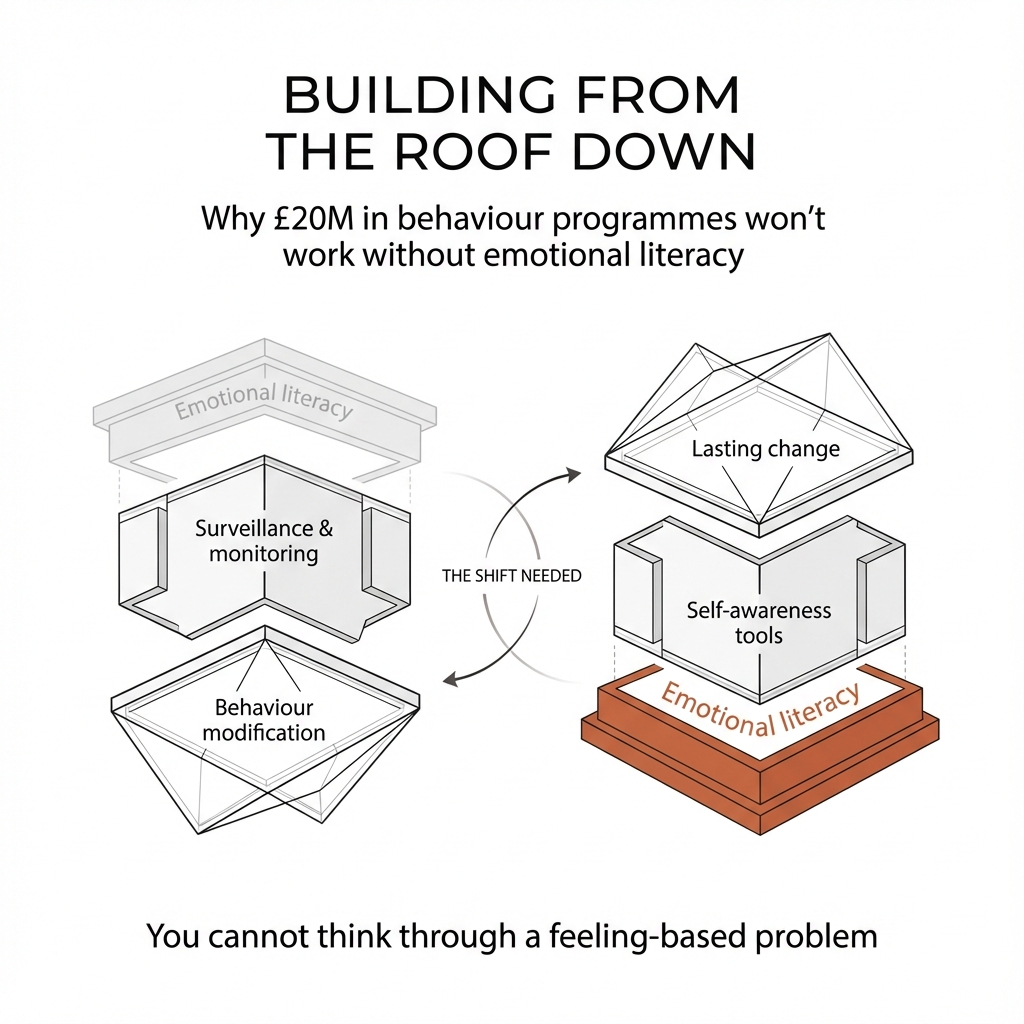
We're trying to build the house from the roof down.
Key insight: Government strategies that focus on behaviour modification without emotional literacy risk creating superficial compliance rather than genuine transformation.
What's Wrong with Behaviour Modification Programmes?
Why behaviour change without emotional awareness creates compliance, not transformation
Behaviour modification aims to reduce actions deemed inappropriate. It focuses on the surface—what you do—without fully understanding the underlying need driving it.
Research confirms what many sense intuitively: this approach leads to suppression of behaviours without addressing underlying causes, potentially causing emotional harm and preventing individuals from learning healthier coping mechanisms.
Here's what I've observed working in personal development and education: when you don't address root causes, you don't create change. You create compliance.
And compliance without understanding is fragile.
The root cause: emotional intelligence and awareness
Root cause issues stem back to emotional intelligence and emotional awareness. The ability to articulate and express emotions constructively rather than overwhelmingly.
Particularly for men, who've been taught through society that emotions are weakness.
But emotions aren't weakness. They're the seat of human strength.
When we ignore emotional aspects, we become vulnerable to exploitation and manipulation. We see this in real time—young men falling prey to misogynistic influencer culture, communities built on exploiting alienation, charismatic figures who've built platforms purely on targeting those who feel left behind.
Without emotional literacy, without tools to process what we're feeling, we can't dismantle the structural apparatus of harm created by unconscious behaviours and lack of emotional awareness.
This isn't just an educational problem. It's a social problem needing attention within families, within direct interpersonal relationships. We can't rely on a top-down solution alone.
Bottom line: Behaviour modification without emotional literacy creates suppression rather than genuine change, because it doesn't address why people act the way they do.
Why These Programmes Risk Becoming Tick-Box Exercises
The pattern: insufficient funding and rushed implementation
When something feels mandatory, you're less likely to engage with it mindfully.
The £3 million allocated to initial teacher training will barely touch the surface of additional infrastructure needed within schools. Between 2021-22 and 2023-24, the Home Office underspent its own budget allocated to violence against women and girls strategy by around 15%—approximately £22 million against a total £149 million budget.
Previous strategies haven't worked because the Home Office produced them "at pace" without developing them based on what actually works. There's little evidence that learning from previous strategies was applied.
History suggests we're about to repeat the same pattern.
What would make these initiatives different?
Bringing boys and men into the conversation rather than pushing them to the margins.
When you push people to the fringes, they become vulnerable to those who've built entire movements on exploiting their sense of alienation. These aren't random influencers—they're sophisticated operators who understand that people seeking connection will follow those who make them feel seen, even when the path leads somewhere harmful.
There's a quote worth remembering: if there is to be a brave new world, our generation will have the hardest time living in it.
We have to be open. We have to be honest with ourselves. We have to recognise that things we once thought acceptable are actually quite harmful. That's a difficult conversation to have, and an even more difficult aspect of self-reflection to engage with.
But seeing this as connection—as a way to build better connections—changes everything.
The shift: from domination to equality
We cannot see each other as resources to be extracted from. We cannot see each other as things rather than people.
The world is changing rapidly. Regressive voices claiming the banner of "traditional values" or "common sense" are doing the opposite of what they claim.
We're witnessing a decline in patriarchal structures and a move towards more equitable frameworks. That's challenging to a hierarchically organised society, which is why many interpret these initiatives as removing power from those who've traditionally held dominance.
But trying to dominate another human being in a non-consensual way is the height of weakness.
The cruel seek to dominate, control and possess. The kind seek to elevate and stand next to each other as equals.
Critical point: Mandatory programmes that exclude families and push young men to the margins create the exact alienation that makes them vulnerable to harmful influencers.
What Works: Teaching Emotions as Energy
What research reveals about effective violence prevention
Research on effective violence prevention programmes reveals a pattern. Universal school-based programmes that work provide students with information about violence whilst changing how they think and feel about it. They enhance interpersonal and emotional skills—communication, problem-solving, empathy, conflict management.
A systematic review found these programmes achieved median relative reductions of:
29% for high school students
18% for elementary students
32% for pre-kindergarten and kindergarten students
The key difference? These programmes prioritise emotional skills development over compliance.
Why you can't think your way through feeling-based problems
Through an educational context, it's vital to introduce practices like EFT tapping. When you're dealing with school-age teenagers, you're working with a confusing collision of hormones, instinct, impulse and intellectual development.
You cannot think your way through a problem that's feeling-based in nature.
As someone who's neurodiverse, I know we feel things first. We process what's called "bottom-up"—from body to mind. When you process emotionally first, then intellectually, you become more powerful. Trying to build from the mind down becomes stale and disconnected.
How emotions as energy creates agency
What we're offering here is a diversification of experience. A recognition that when we work with emotions as energy, we learn to name feelings. We learn the texture of feelings, the nuances of what triggers them within us.
We learn where we're being manipulated and guided to feel something—and we can make a different choice.
This multimodal approach takes into account both body and mind. It gives young people tools to regulate their energy and emotions. It provides the vocabulary to understand that people aren't possessions or masters to one another.
People are people.
The more we see each other as that, the less power these shadowy influences have over us.
The evidence: Programmes that enhance emotional skills achieve 18-32% reductions in violence because they address how people feel, not just what they do.
How Online Spaces Weaponise Emotional Manipulation
The scale of the problem
Online spaces, particularly in the post-2020 landscape, thrive on isolation and alienation.
New research reveals:
Over a third of pupils aged 11-19 heard comments in just the past week that made them worry about girls' safety
More than half witnessed comments they'd describe as misogynistic
These spaces allow people to fall into cult-like groups with cult-like followings around charismatic figures they've essentially elevated to gods. There's a void of connection in many of our lives. We cannot replace genuine connection by falling into fringe communities built on exploitation.
Why digital literacy requires emotional literacy
Digital literacy matters because we're living in a time when people have lost the ability to discern between what serves their interests and what's acting like a Pied Piper effect, leading them toward someone else's agenda.
These fringe communities thrive on emotional manipulation.
When we see emotion as weakness, we shut out efforts to build emotional understanding. We all have a deep and different emotional language of experience and expression. If we're going to help people equip themselves with understanding of emotion, we need to recognise they express and experience it differently.
This broadens the conversation beyond outdated tropes that paint certain responses as "weak" or "not masculine." These age-old ideas encourage people to value brittleness and immovability as strength.
When you choose to be brittle, you'll eventually come up against something that breaks you.
Then you see it as a failing of society rather than taking accountability for a failure of approach and attitude—which can be changed if you do the work.
How to recognise emotional manipulation online
One hallmark of these communities: they rally around conspiratorial ideas, claiming to be truth-seekers who "see through the matrix." But I've never met a happy conspiracy theorist. I've never met one who's actually in control of their own anger either.
The question becomes: are you actually thinking this, or are you feeling this and being made to feel righteous? Are you genuinely left behind by the world, or are you living in a world you don't understand because you've disengaged from it?
If something makes you feel something, there's emotional manipulation at play. Our world runs on a currency of emotional manipulation.
When you see something striving to stir the pot with emotion, recognise you've become the puppet of those with vested interests—whether that's more subscriptions, more course purchases, more money in their pocket, or more votes for their political movement.
It all comes back to power and money, driven by emotion.
The minute we start breaking the chain of emotional response, we don't just begin solving issues like misogyny. We start tackling a whole wider set of systemic issues by recognising that being pushed and prodded through the emotional doorway is no way to live.
Key recognition: Our world runs on a currency of emotional manipulation—therefore, teaching young people to recognise when they're being emotionally manipulated is essential violence prevention.
Why Mindfulness Alone Isn't Enough
The Western intellectualisation problem
We cannot solve emotionally exploitative issues with mindfulness alone.
In the Western world, everything has become far too intellectualised. If we're not going to deal with feelings as we experience them in the body, we don't have a hope of solving these problems.
What makes EFT tapping effective for emotional regulation
This is where tools like EFT tapping become vital. It's non-invasive, easy to learn, easy to pick up. It's a somatic intervention that allows people to directly engage with the physical response and experience of emotion whilst they're talking.
They don't get pulled into unconscious responses where they start acting out through their behaviours.
This can be done in assemblies, in sessions, as part of a conversational framework. With it being so simple to learn, we have a tool that can shepherd conversations in a more helpful direction rapidly.
We don't need big, broad-brush solutions. The real issue is people recognising when they're being emotionally manipulated.
Understanding emotional awareness as an unfolding scale
Understanding David Hawkins' Map of Consciousness helps here—though it's the most misquoted thing I've seen working in the wellbeing space. People view it as a hierarchical scale rather than an unfolding scale. Emotional awareness expands your perspective and worldview. It's not about being "higher" or "better"—it's about having more range.
It's just not seeing emotions as any different to other aspects of ourselves. It's just part of the landscape.
I think we're overthinking this. The problem with everything being brought back to the mind in the Western world is that you cannot think your way through a problem that's feeling-based in nature.
When you process emotionally then intellectually, you become more powerful. It's like trying to build a house from the roof down—starting with mindset makes everything stale.
What we're offering is a diversification of experience and a recognition that working this way allows us to name feelings, learn their texture, understand their nuances and what triggers them within us.
We learn where we're being manipulated and can make different choices about how and what we want to feel.
Why it matters: You cannot think your way through a feeling-based problem—embodied practices like EFT tapping address emotions where they're experienced, in the body.
How to Navigate Faith Communities and Cultural Sensitivity
Why inclusion matters more than standardisation
When it comes to families and faith communities, inclusion in consultation and conversation is vital.
Schools can be flexible in their approach. Faith schools are allowed to teach within the tenets of their faith. But this creates tension with standardised interventions that don't account for diverse cultural approaches to relationships, spirituality and personal development.
There should be an option for families to be present in some of these lessons or sessions. They shouldn't be excluded.
If we're talking about mandatory respect, we need to look at intersectional factors affecting different communities. Different people come with different perspectives—faith, social, political.
The idea that we're trying to create something better for everyone is key. Then it becomes inviting rather than "you are wrong, so we're going to make this right."
It has to transcend that discussion, even though we can agree that gender-based discrimination and discrimination of any kind has no place in a modern society.
What research says about effective interventions
Research on effective programmes confirms this: interventions should be comprehensive, appropriately timed, utilise varied teaching methods, have sufficient dosage, be administered by well-trained staff, provide opportunities for positive relationships, be socioculturally relevant, and theory-driven.
Violence prevention programmes aim to raise awareness, change attitudes, normative beliefs, motivation and behavioural responses. That's fundamentally different from top-down behaviour modification.
Beyond top-down solutions
We need to take an inclusive focus first. But things shouldn't be only top-down. These are conversations people need to have with their friends, within their families, at large.
We shouldn't be afraid of having challenging conversations because someone might get upset. We're living in a time when people are being bullied into silence because they don't want to accept that their worldview might be regressive.
The world has moved on. Their world is getting statistically smaller.
The approach: Invitation rather than imposition—programmes must be socioculturally relevant and include families rather than standardising across diverse communities.
Why Restorative Approaches Work Better Than Punishment
How to invite people in rather than push them out
We need to invite people into the conversation rather than pushing them to the fringes.
There will be people who don't want to do this work. As the world evolves, it will be difficult for them. They'll get left behind. But they need to be given the opportunity to open up and come forward with the wave of change rather than being excluded from the starting point.
This speaks to a multimodal need for a variety of language and approaches. We need to make sure we aren't leaving anyone behind.
The minute people start to get left behind, they disengage. When people disengage, it's difficult to get them back into the programme.
What the research shows about emotional literacy
We have to lead with kindness and understanding. For those who've fallen on the wrong side of perspective in the past, we need to take a restorative approach rather than a punitive one.
People need the ability to learn, grow and evolve. They need to be able to change on the road ahead rather than feeling like the die has been cast and they're left out of the conversation entirely.
Research on emotional literacy supports this: children who have a strong foundation in emotional literacy tolerate frustration better, get into fewer fights, and engage in less self-destructive behaviour. They're healthier, less lonely, less impulsive, more focused, and they have greater academic achievement.
Many theorists advocate for emotional intelligence learning and empathy training as an effective prevention strategy against violence.
Setting boundaries whilst accepting people where they are
The approach has to accept people where they are. It's not about writing off heinous comments as jokes. The person making the comment doesn't get to decide if something is harmful or offensive—the person on the receiving end does.
Ideas that women are property and possessions have no place in the twenty-first century. It's a failing of the individual to turn their own personal issues into a societal problem, then exploit others who are also victims to create movements that have no place.
Core principle: Restoration over punishment—people need the ability to learn and evolve rather than feeling permanently excluded from the conversation.
What Success Could Look Like in a Decade
The vision: a society built on emotional release rather than suppression
If we get this right, we'll have a more diverse and integrated society that's not at risk of regressive movements spearheaded by people who don't understand a complex, nuanced world.
This is future-proofing. Creating less room for those who seek to exploit and dominate.
It can create a more mindful society, a more cohesive society, a more creative society.
Some of the greatest indicators of what it means to be human are imagination, passion and innovation. In a world that's having the colour drained out of it, where people are obsessed with material aspects and believe that if something cannot be monetised it doesn't have value—we need this shift.
If we have the emotional release valve, we allow people to have more diverse interests in their lives. We allow people to create and express themselves differently across the board.
It opens us up to so much more potential with this simple act of having emotional release.
The path forward: what we actually need
The government's £20 million strategy has good intentions. Violence against women and girls is a national emergency that demands action.
But intentions without the right approach create compliance, not transformation. Behaviour modification without emotional literacy creates suppression, not change. Surveillance without self-awareness creates control, not safety.
What we need is a multimodal approach that:
Recognises emotions as energy
Provides practical tools for regulation
Invites rather than excludes
Restores rather than punishes
Bridges the spiritual-practical-human-scientific realms
We need to stop trying to build the house from the roof down.
We need to start with the foundation—teaching young people the texture of their feelings, the vocabulary for their emotional experience, and the agency to choose how they respond rather than react.
That's not just violence prevention. That's creating a society where imagination, passion and innovation can flourish because people aren't constantly managing unprocessed emotions or being manipulated through them.
That's the future worth building.
Success metric: A creative, cohesive society where emotional literacy creates space for innovation rather than a world where people are manipulated through unprocessed emotions.
Frequently Asked Questions
Can behaviour modification programmes prevent violence without emotional education?
No. Behaviour modification creates compliance rather than transformation because it doesn't address the emotional patterns driving harmful actions. Research shows that suppressing behaviours without addressing underlying causes can cause emotional harm and prevent people from learning healthier coping mechanisms. Effective violence prevention requires emotional literacy—teaching people to recognise, name and regulate emotions as energy.
What makes emotional literacy more effective than behaviour modification?
Emotional literacy addresses root causes rather than symptoms. Universal school-based programmes that enhance emotional skills (communication, empathy, conflict management) achieve 18-32% reductions in violence because they change how people think and feel, not just what they do. Children with strong emotional literacy tolerate frustration better, get into fewer fights, engage in less self-destructive behaviour, and have greater academic achievement.
How does EFT tapping help with emotional regulation in schools?
EFT tapping is a somatic intervention that allows people to directly engage with the physical response and experience of emotion whilst they're talking. It's non-invasive, easy to learn, and can be done in assemblies, sessions, or as part of conversational frameworks. Because you cannot think your way through a feeling-based problem, embodied practices like EFT tapping address emotions where they're experienced—in the body—preventing people from getting pulled into unconscious responses where they act out through their behaviours.
Why are young men particularly vulnerable to misogynistic influencer culture?
When programmes push young men to the margins rather than inviting them into conversation, they become vulnerable to sophisticated operators who exploit their sense of alienation. Men are taught through society that emotions are weakness, which shuts out efforts to build emotional understanding. Online spaces thrive on isolation and alienation, allowing people to fall into cult-like groups around charismatic figures. Without emotional literacy and tools to process feelings, young men become susceptible to communities built on emotional manipulation.
How can we recognise emotional manipulation in online spaces?
If something makes you feel something, there's emotional manipulation at play. Our world runs on a currency of emotional manipulation. One hallmark: communities rally around conspiratorial ideas, claiming to be truth-seekers. The question becomes: are you actually thinking this, or are you feeling this and being made to feel righteous? When you see something striving to stir the pot with emotion, recognise you've become the puppet of those with vested interests—whether subscriptions, course purchases, money, or votes.
How can relationship education programmes work with faith communities?
Inclusion in consultation and conversation is vital. Families should have the option to be present in some lessons or sessions rather than being excluded. The approach must be inviting rather than "you are wrong, so we're going to make this right." Research confirms that effective interventions should be socioculturally relevant, administered by well-trained staff, and theory-driven. Violence prevention programmes must look at intersectional factors affecting different communities and recognise that different people come with different perspectives—faith, social, political.
What's the difference between restorative and punitive approaches?
Restorative approaches invite people into conversation and give them the ability to learn, grow and evolve. Punitive approaches push people to the fringes, where they disengage. When people disengage, it's difficult to get them back into the programme. Leading with kindness and understanding allows those who've fallen on the wrong side of perspective to change on the road ahead rather than feeling the die has been cast and they're permanently excluded. The minute people start to get left behind, they become vulnerable to harmful influences.
Why isn't mindfulness alone enough to address violence prevention?
In the Western world, everything has become far too intellectualised. Mindfulness alone cannot solve emotionally exploitative issues because you cannot think your way through a problem that's feeling-based in nature. If we're not going to deal with feelings as we experience them in the body, we don't have a hope of solving these problems. When you process emotionally first, then intellectually, you become more powerful. Starting with mindset alone—building from the mind down—becomes stale and disconnected from embodied experience.
Key Takeaways
Behaviour modification without emotional literacy creates compliance, not transformation. The UK government's £20 million strategy risks becoming another tick-box exercise if it doesn't address the emotional patterns driving harmful behaviours.
Effective violence prevention requires embodied practices, not just intellectual understanding. Research shows programmes that enhance emotional skills achieve 18-32% reductions in violence because they address how people feel, not just what they do.
You cannot think your way through a feeling-based problem. Tools like EFT tapping work because they engage with the physical experience of emotion in the body, preventing unconscious reactive behaviours.
Our world runs on a currency of emotional manipulation. Teaching young people to recognise when they're being emotionally manipulated—especially in online spaces—is essential violence prevention that addresses root causes.
Invitation works better than exclusion. Programmes that push young men to the margins create the exact alienation that makes them vulnerable to harmful influencers. Restorative approaches that invite people into conversation are more effective than punitive approaches.
Emotional literacy is the foundation for a creative, innovative society. When people have emotional release rather than suppression, they have space for imagination, passion and innovation—future-proofing against regressive movements built on exploitation.
Success requires a multimodal approach. Effective violence prevention recognises emotions as energy, provides practical regulation tools, invites rather than excludes, restores rather than punishes, and bridges spiritual-practical-human-scientific realms.
References
Centers for Disease Control and Prevention. (n.d.).School-Based Violence Prevention: Health Impact in 5 Years. The Community Guide. https://archive.cdc.gov/www_cdc_gov/policy/hi5/violenceprevention/index.html
National Audit Office. (2025, January).Tackling violence against women and girls. https://www.nao.org.uk/wp-content/uploads/2025/01/tackling-violence-against-women-and-girls.pdf
Office for National Statistics. (2025, July 23).Developing a combined measure of domestic abuse, sexual assault and stalking, England and Wales. https://www.ons.gov.uk/peoplepopulationandcommunity/crimeandjustice/articles/developingacombinedmeasureofdomesticabusesexualassaultandstalkingenglandandwales/july2025
UK Government Department for Education. (2025, July 15).Misogynistic myths kicked out of classrooms to protect children. GOV.UK. https://www.gov.uk/government/news/misogynistic-myths-kicked-out-of-classrooms-to-protect-children
