
Which World Are You In Right Now? A Guide to Nervous System Regulation and Conscious Living
Which World Are You In Right Now? A Guide to Nervous System Regulation and Conscious Living
Which world are you living from right now? The answer shapes everything.
Here is a question worth sitting with for a moment.
When you move through your day and something happens that pulls you off course, whether that is a difficult conversation, a piece of news, a memory that surfaces unexpectedly, a situation that sends your heart rate up, which version of yourself shows up? Do you react before you have even decided to? Do you pull inward and disappear? Or do you meet it from a place of genuine presence and choice?
Most people, if they are being honest, are somewhere between the first two most of the time. And most people have spent years trying to fix that with tools that live entirely above the neck. The affirmations. The mindset work. The journalling. The gratitude lists. The manifestation practices. Writing things down repeatedly and wondering why nothing shifts at the level that actually matters.
This is not a strategy problem. It is a states problem. And until we address it at that level, we are working on the roof whilst the foundations are doing something entirely different.
This guide offers a different map. One that I developed over seven years following a psychedelic-assisted psychotherapy research trial in 2019, refined through hundreds of sessions working with real people on real patterns. It is called the Three Worlds framework, and it gives you a language for where you are and a pathway for what to do about it that no amount of positive thinking can replace.
We will also look at how this maps onto one of the most important developments in neuroscience of the last thirty years, Polyvagal Theory, and why understanding the overlap between the two gives you something genuinely powerful: a way to navigate your own nervous system consciously, rather than being navigated by it.
The central question: Which world am I in right now? The moment you can answer that honestly is the moment you are no longer trapped in it.
Why Most Nervous System and Personal Development Advice Misses the Point
We live in a world that is drowning in information about wellbeing and almost completely starved of the tools to actually create it.
You have probably noticed that most of it is one-dimensional. It addresses either the thinking, or the doing, or the being, but rarely all three together in a way that accounts for the actual architecture of how human beings work. And the result is that most people get temporary relief, partial results, or find themselves back at square one wondering what they are doing wrong.
They are not doing anything wrong. They are using the right tools in the wrong order. Or more accurately, they are working on the upper floors of a building without ever addressing what is happening in the foundations.
The problem with top-down approaches
Top-down approaches to change work from the mind downward. They try to think you into a different feeling, reason you into a different behaviour, or reframe your way into a different perspective. There is real value in this. The problem is that the mind does not have full jurisdiction over the body's emotional and physiological states.
When your nervous system is running a threat response, the prefrontal cortex, the part responsible for reasoning, perspective, and choice, goes partially offline. You can know something is irrational. You can repeat affirmations about abundance while your body is vibrating with scarcity. You can set intentions from a place of anxiety and wonder why those intentions keep collapsing.
The nervous system does not respond to intellectual persuasion. It responds to felt safety. And felt safety is a body experience, not a thought.
The bottom-up principle: We are building from the ground up here. When change comes from the ground up it is natural, it is growing, it is flowing through you. When we try to impose it from the roof down, we are fighting against the process.
What this means in practice
It means the sequence matters enormously. You cannot sustainably build confidence on top of an unregulated nervous system. You cannot install new beliefs on top of old emotional patterns that have not been processed. You cannot live in the creative, generative state that you know is available to you if your body is still running scripts written by experiences from years ago.
The work has to go in a specific order. Regulate the nervous system. Process the emotional experience held in the body. Update the beliefs that formed from those experiences. Build the new patterns from a genuinely different physiological foundation.
That is the ground-up approach. And it is the opposite of what most personal development frameworks teach.
The Three Worlds Framework: A Somatic Model for Conscious Living
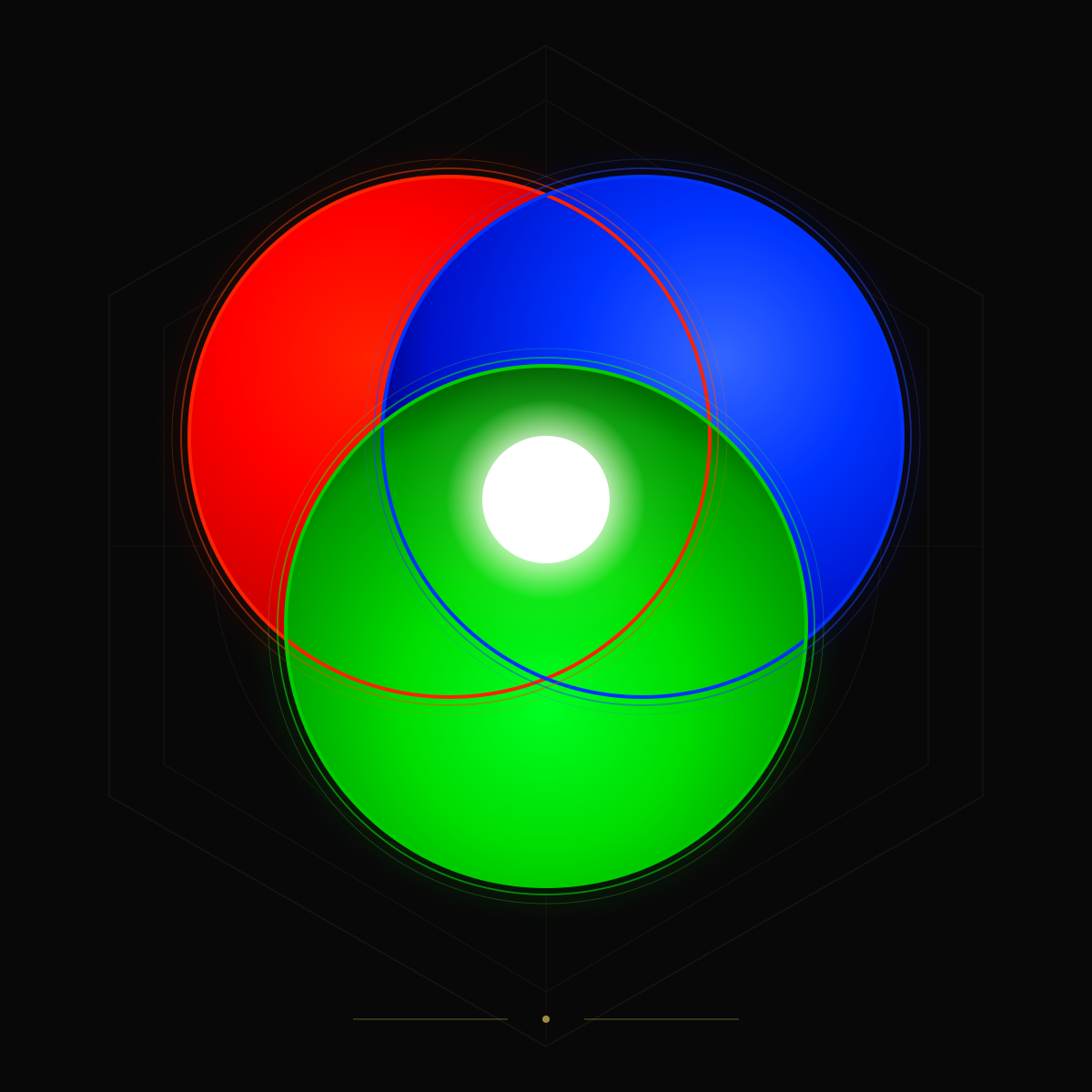
Red, blue and green are the primary colours of light. When combined, they produce white. When integrated, so do we.
The Three Worlds is a somatic response model for conscious living. Somatic means of the body. So, what we are talking about here is the physical, felt experience of how your emotional states shape your perception, your choices and the reality you are actually creating, not the one you are trying to think your way into.
Emotion is not weakness. It is the seat of human strength. The difficulty is not emotion itself. The difficulty is when we shut it out, suppress it, or let it run us unconsciously. Because when that happens, it builds. And it either explodes outwardly or implodes inwardly, or it leaks out through our actions and decisions in ways we do not even recognise as emotional.
The three worlds coexist within all of us at all times. They are not stages you pass through once and leave behind. They are dynamic states that you move in and out of through your day, your week, your year. The question is not whether you will visit all three. You will. The question is which one you are living from most of the time, and whether you are doing that consciously or not.
Red, blue and green are the primary colours of light. When you mix them together, you get white light: wholeness, clarity, truth. That is what we are working towards. Not the elimination of the red or the blue. Their integration. The full spectrum consciously held.
The Red World: Reactive, Primal, Unconscious

The red world is not bad. It is primal energy without a conscious hand on the wheel.
The Red World is the reactive world of primal energy. It is explosive, outward, dense. It can feel like the gravity has doubled, or like the chair is made of velcro when you try to take action on the things that matter to you. Or it flips the other way and becomes an outrage machine, surging through you like a wave of heat before you have even decided to respond.
You do not need to look far to see the Red World in action. Open any social media app. Turn on the news. Walk past a newsstand. We are systematically encouraged to be angry and scared of everything. And not angry about the right things. Angry about the things that keep us divided from each other rather than the things that would actually move us forward if we addressed them together.
What the Red World feels like in the body
In the body, the Red World shows up as tightness in the chest. A clenched jaw. Racing thoughts. Restlessness. Surges of heat. That volcanic feeling when something triggers you and you are already in motion before your conscious mind has caught up. It is the body in full sympathetic activation, mobilised for a threat that may be real, remembered, or simply perceived.
In perception, the Red World narrows everything down. Threats feel like they are everywhere. It is always someone else's fault. It is us versus them. There is a constant sense of urgency, of firefighting, of your energy leaking out of you in all directions while the horizon of what feels possible gets narrower by the day.
All actions taken from the Red World are essentially unconsciously driven. In this state, we become puppets: of expectation, of other people's influence, of systems that benefit from us staying reactive, divided and depleted.
The key insight: The Red World is not the enemy. That primal force, when brought into consciousness and directed, is extraordinary power. The problem is not the energy. It is the absence of a conscious hand on the wheel.
How the Red World maps onto the nervous system
In Polyvagal Theory terms, the Red World corresponds to sympathetic nervous system activation. This is the fight-or-flight branch: the accelerator pressed to the floor, the body prepared for physical action in response to perceived threat. Heart rate elevated. Cortisol high. Digestion paused. Rational thinking compromised.
This state is extraordinarily useful when the threat is real and present. It becomes a problem when the threat is a habit, a pattern, a reflexive interpretation that the nervous system has been running for years without anyone asking whether it is still accurate.
The Blue World: Reflective, Immersed, Adrift

The Blue World is a deeply human place. The problem is setting up permanent residence there.
The Blue World is where we go when we have seen enough of the Red World's chaos and want no part of it. We pull inward. We reflect. We process. We intellectualise. And there is something genuinely beautiful about this, because the Blue World is where art comes from, where empathy lives, where we have access to the broader spectrum of human experience.
The problem is that the Blue World's reflective nature gets hijacked. What starts as meaningful introspection becomes an endless loop of analysis without movement. Everything becomes a thought. You find yourself adrift in the middle of the ocean with no rudder, bobbing about in what feels like depth but is actually just immersion without direction.
Reflection without movement creates heaviness. And a lot of self-help culture, paradoxically, deepens the Blue World's grip. How many approaches advocate retreating from society, pulling up the drawbridge, endless healing loops that take you back into the mud and then hose you down without ever asking where you are heading?
What the Blue World feels like in the body
In the body, the Blue World is a heaviness. A fatigue that is not quite physical tiredness. A sinking feeling. Low energy. The weight of everything. That quiet but persistent sense that something is wrong that you cannot quite name or locate. Things feel too big. What is the point? The paralysis of analysis, where you can see all the options clearly and move towards none of them.
In perception, the Blue World produces a binary view of emotion: things are good or things are bad, with not much room for the nuance in between. There is a growing sense of alienation, from yourself, from your life, from the people around you, from society. The Blue World has you holding onto everything, which means the body is carrying it all, which means it costs you energy just to stay.
The truth about the Blue World: We need it. Reflecting and introspecting are not bad things. Going in to come out is essential. The problem is going in to stay. The store is not meant to be a home.
How the Blue World maps onto the nervous system
In Polyvagal Theory terms, the Blue World corresponds most closely to the dorsal vagal state: the oldest branch of the vagus nerve, the body's protective shutdown response. When the system has been in sympathetic overdrive for long enough without resolution, the dorsal vagal brake activates. Energy drops. Motivation disappears. Connection feels effortful. The emotional flatness of burnout, the numbness of chronic stress, the dissociation of feeling present but not really there: these are all Blue World signatures in the nervous system.
It is worth being clear: this is not weakness. It is the body protecting itself. The nervous system is doing exactly what it evolved to do. The work is not to shame that response but to understand it and create the conditions that allow the system to come back online.
The Green World: Conscious, Creative, Self-Directed

The Green World is not a permanent destination. It is the state from which you become the architect of your own experience.
The Green World is where you become the predominant creative force in your own life. It is conscious, self-directed, alive. It is not a place without difficulty. The Red and Blue worlds do not disappear when you are operating from the Green. If anything, you become more aware of them. But you are relating to them differently. You are not being run by them. You are working with them.
In the Green World, energy moves through you rather than getting stuck. You can meet what arises, feel it, let it inform you, and put something meaningful back out into the world. You can channel what the Blue World holds without drowning in it. You can access what the Red World's primal force offers without losing your footing. You are performing alchemy with your experience rather than being buried by it.
What the Green World feels like in the body
In the body, the Green World has a quality of aliveness and ease together. A sense of being grounded and present rather than tethered to the past or anxious about the future. Thoughts feel clearer. Decisions feel more aligned. There is curiosity. There is appetite for the things that matter to you. A sense of agency, of being the one with the wheel in your hands.
For many people, when they first access the Green World consistently through this kind of work, the feeling is unfamiliar. Not because it is foreign to them. Because they have not had permission to stay there for long before something pulled them back. The work of nervous system regulation is in large part the work of extending the time you spend in the Green and building the capacity to return there when life takes you elsewhere.
How the Green World maps onto the nervous system
In Polyvagal Theory terms, the Green World is the ventral vagal state: the newest branch of the vagus nerve, associated with social engagement, safety, connection, and the full availability of the rational mind. In this state, the prefrontal cortex is online. Emotional experience can be felt and processed rather than suppressed or overwhelming. New information can be integrated rather than filtered through a threat lens.
This is the physiological state in which genuine change becomes possible. Not because the other states have been eliminated, but because there is now enough safety in the system to work with them consciously.
The Green World is not the finish line: It is the foundation from which everything else becomes accessible. The platform from which real transformation is built.
Source: Porges SW. Polyvagal Theory: A Science of Safety. Frontiers in Integrative Neuroscience (2022)
The Three Worlds and Polyvagal Theory: Why the Map Matters
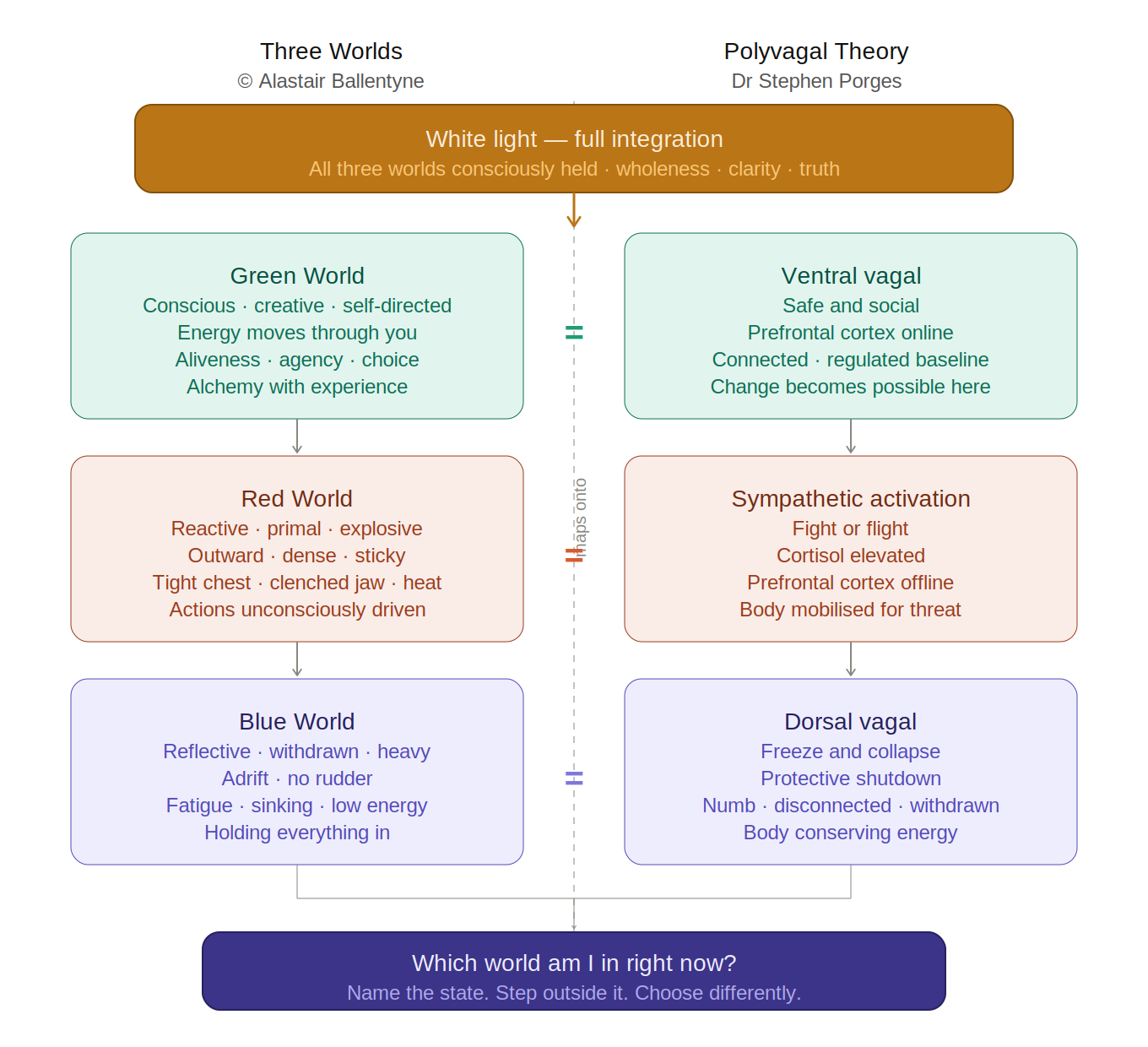
Two maps, same territory. The Three Worlds gives you the navigation. Polyvagal Theory gives you the science.
Polyvagal Theory, developed by neuroscientist Dr Stephen Porges, describes the autonomic nervous system through three distinct states determined by which branch of the vagus nerve is active. Understanding the overlap between Polyvagal Theory and the Three Worlds gives you something more powerful than either framework alone: both the science of what is happening in your physiology and the practical language to navigate it in real time. Especially as it doesn't require any heavy studies, the Three Worlds is intentionally meant to be accessible.
The parallel map
Red World corresponds to sympathetic activation. Fight-or-flight. The body mobilised for threat. Actions unconscious, reactive, driven by survival rather than choice.
Blue World corresponds to dorsal vagal shutdown. The body's protective collapse response. Withdrawal, numbness, heaviness, the freeze beneath the surface of the reflection.
Green World corresponds to ventral vagal regulation. The state of safety, social connection, creative engagement, and genuine agency. The state from which life is built rather than survived.
And white light: the integration of all three, held consciously, navigated with awareness. That is what Polyvagal Theory calls a well-regulated nervous system. What the Three Worlds calls living from the full spectrum.
Why having two maps is better than one
Polyvagal Theory gives you the science. It explains what is happening neurologically and physiologically when you are reactive, withdrawn, or connected. It explains why top-down approaches have a ceiling and why the work has to go body-first.
The Three Worlds gives you the practical navigation. It gives you a question you can ask yourself in the middle of a difficult moment, which world am I in right now, and an immediate orientation. Not a clinical diagnosis. A compass reading.
The moment you can name the state, you are no longer entirely inside it. You have introduced a gap between stimulus and response. And that gap is where choice lives.
The most important question in this work: Which world am I in right now? Ask it often. It will change everything.
Source: Porges SW. The Polyvagal Theory (2011). W.W. Norton
Source: Dana D. Polyvagal Theory in Therapy: Engaging the Rhythm of Regulation (2018). W.W. Norton
Signs of a Dysregulated Nervous System: What to Look For
Dysregulation is not a character flaw or a personal failing. It is a physiological state. The nervous system has learned, through repeated experience, that the world requires a certain level of vigilance to navigate. And it has become very good at maintaining that vigilance, even when the original circumstances that required it are long gone.
Red World dysregulation: reactive/sympathetic patterns
Persistent anxiety, the sense that something is about to go wrong
Reactivity that arrives before you have decided to respond
Difficulty relaxing even when nothing is happening
Restlessness, racing thoughts, difficulty concentrating
Physical sensations: tight chest, clenched jaw, heat surges, shallow breathing
Chronic firefighting, always a problem to attend to
Energy leaking in all directions with no sense of where it is going
Blue World dysregulation: reflective/dorsal patterns
Persistent fatigue that sleep does not resolve
Emotional flatness or numbness, the lights are on but nobody is home
Withdrawal from people, activities, things that used to matter
The paralysis of analysis: seeing all the options, moving towards none
A quiet but persistent sense that something is wrong that you cannot name
Heaviness in the body, a sinking feeling, low motivation
Alienation from yourself and your own life
What burnout actually is
Burnout is what happens when the Red World has been running at full tilt for long enough that the body invokes the Blue World as a protective shutdown. It is not a time management problem. It is not a weakness. It is the nervous system doing exactly what it evolved to do: when fight and flight are not resolving the threat, collapse and conserve.
Recovery from burnout that addresses only the cognitive level, rest more, think differently, take a holiday, produces temporary relief and recurrence. Recovery that addresses the nervous system directly produces something different: a genuine shift in baseline.
Source: World Health Organization: Burn-out an occupational phenomenon (2019)
How to Regulate Your Nervous System: Practical Pathways Through the Worlds

Regulation is not about staying calm. It is about building the capacity to return.
Nervous system regulation is not about flattening all experience into a permanent state of serene neutrality. It is about building the capacity to move through the Red and Blue Worlds without getting stuck there, and to return to the Green World as your operational baseline.
The practices below work at different layers of the system. Some are immediate, for use in the moment. Some are cumulative, built through consistent daily practice. All of them are working with the body, not against it.
In the Red World: coming down from activation
When you find yourself in the Red World, the priority is reducing the physiological charge before attempting any cognitive work. Trying to reason with yourself from sympathetic activation is like trying to navigate with a map while someone is shouting in your ear. Address the shouting first.
Extended exhale breathing: inhale for 4 counts, exhale for 8. The extended exhale directly activates the parasympathetic branch and stimulates the vagus nerve. Even five minutes produces measurable change.
Physical movement: walk, shake out the hands, move the body. Sympathetic activation prepares you for physical action. Give it some.
Orienting: slowly turn your head and take in the room. Notice five things you can see. This is a direct signal to the nervous system that the environment is safe.
Cold water on the face or wrists: activates the dive reflex and stimulates vagal tone rapidly
EFT Tapping helps bring you back from the brink as an integration and regulation practice
Belief Coding® allows you to address the cause at the root and any related subconscious beliefs driving that activation to break the cycle from a long term perspective.
In the Blue World: coming up from shutdown
Coming out of the Blue World requires gentleness and patience. The dorsal vagal shutdown is a protective response. Forcing activation before the system feels safe to come back online can trigger a return to the Red World. The movement needs to be gradual.
Small acts of connection: a brief message to someone who feels safe, a moment of eye contact with another person, the presence of an animal. Ventral vagal activation is fundamentally social.
Gentle movement: not intense exercise, which can tip back into sympathetic activation, but slow, rhythmic, gentle movement. Walking. Swaying. Gentle stretching.
Humming or singing: vibration in the throat directly stimulates the vagus nerve and activates the ventral vagal branch.
Going in to come out, not to stay: use the Blue World's reflective quality with intention. Journal not to circle the problem but to find the thread that leads somewhere.
EFT Tapping again can help move you through any closedown, rumination and thought-loops associated with the blue world
Belief Coding® works at the root to help you come out of these patterns by using memory reconsolidation in the subconscious for a more immediate shift
Building the capacity for the Green World
The Green World is not a reward for doing the other work perfectly. It is a state that becomes increasingly accessible as the nervous system builds what is called vagal tone: the resilience and responsiveness of the vagus nerve. Higher vagal tone means greater flexibility, a wider window of tolerance, and a stronger capacity to return to regulation after activation.
Consistent daily practice matters more than occasional intense effort. The nervous system learns through repetition and safety, not through force.
EFT tapping works directly at the intersection of emotional memory and nervous system activation, reducing the charge held around old experiences so the system can update its threat map.
Time in nature consistently reduces cortisol and activates parasympathetic tone. This is not metaphor. It is measurable physiology.
Sleep, nourishment, and genuine rest are not optional extras in this work. They are the infrastructure.
Source: Breit S et al. Vagus Nerve as Modulator of the Brain-Gut Axis. Frontiers in Psychiatry (2018)
Source: Hunter MR et al. Urban Nature Experiences Reduce Stress. Frontiers in Psychology (2019)
The Role of Emotional Memory in Nervous System Dysregulation
Your nervous system is not responding to what is happening right now. It is responding to what it predicts will happen, based on every previous experience it has logged as relevant. This predictive processing is extraordinarily efficient. It is also the primary mechanism behind chronic dysregulation.
How the body stores experience
When we have experiences that are overwhelming, particularly early in life when the nervous system is still developing, those experiences are encoded not just cognitively but physiologically. The body stores the felt sense: the contraction, the activation pattern, the emotional charge. Later, when something resembles that original experience, even subtly, even below conscious awareness, the nervous system re-activates the same response.
This is not irrational. It is the body doing its job, running pattern recognition at extraordinary speed to keep you safe. The problem is that it is running on an outdated map. The response that was appropriate then is firing in contexts where it is no longer accurate.
These stored patterns are the ring fences around areas of your life. The invisible boundaries that make certain actions feel genuinely impossible, certain possibilities feel like they are not for someone like you, certain situations trigger a response that seems entirely disproportionate to what is actually happening.
The reframe that changes everything: Your nervous system is not failing you. It is responding exactly as it was trained to respond. The question is whether that training is still accurate, and whether you are ready to update it. Because more often than not, many people I've worked with never chose how their nervous system responds. It adapted to their experiences primarily to keep them safe in the future.
Why this matters for the Three Worlds
In Three Worlds terms: the Red and Blue World patterns that run us most persistently are not random. They are attached to specific memories, specific experiences, specific moments when the nervous system concluded something about what the world is, what other people are, and what is safe or possible for you. Those conclusions became beliefs. And those beliefs continue to shape perception, choice and behaviour long after the original experience has passed.
The work of moving towards the Green World is not just a matter of choosing to be there. It is the work of releasing the emotional charge held around those experiences so that the body's threat map can be updated. So that the ring fences can come down. So that the white light of integration becomes not a concept but a lived reality.
Source: Van der Kolk B. The Body Keeps the Score (2014)
Source: Ecker B, Ticic R, Hulley L. Unlocking the Emotional Brain (2012). Routledge
EFT Tapping as a Nervous System Regulation Practice

EFT works at the intersection of the nervous system and emotional memory. No equipment, no specific location, available whenever you need it.
EFT, Emotional Freedom Techniques, is often described as psychological acupuncture without the needles. We are tapping on the same acupressure points used in Traditional Chinese Medicine, but rather than needles we are using our fingertips, and rather than a physical complaint we are addressing the emotional and physiological charge held around memories, patterns and beliefs.
What the tapping does, in precise terms, is send calming signals directly to the amygdala, the brain's threat-detection centre, while we simultaneously hold the emotional content of what we are working with in mind. This dual process is the mechanism. You are activating the threat response and providing a deactivating signal at the same time. Over repeated rounds, the amygdala learns to associate the previously threatening material with a neutral physiological state.
Why this matters for the Three Worlds
In Three Worlds terms, EFT is one of the most direct tools available for moving out of the Red and Blue World patterns and building genuine access to the Green. Not by bypassing the difficult material. By processing it at the level where it lives: in the body.
The tightness in the chest that is the Red World signature. The heaviness and the sinking feeling of the Blue. These are not psychological metaphors. They are physiological states with specific sensory qualities in specific locations in the body. EFT works with exactly that. Where do you feel it? What does it feel like? What is its quality, its temperature, its weight? That somatic precision is not incidental to the work. It is the work.
And because EFT requires no equipment, no specific setting and no particular circumstances, it is available precisely when you most need it. In the middle of the Red World surge. In the depths of the Blue World weight. Anywhere, at any time.
The practical reality: Nervous system regulation tools that only work in ideal conditions are not really regulation tools. EFT travels with you. It is available wherever the state arises.
Frequently Asked Questions About Nervous System Regulation and the Three Worlds
What is nervous system regulation?
Nervous system regulation is the capacity of the autonomic nervous system to move fluidly between states of activation and rest in response to what is actually happening, and to return to a baseline of physiological safety. In Three Worlds terms, it is the capacity to move through the Red and Blue Worlds without getting stuck there and to operate from the Green World as your functional baseline.
What are the signs of a dysregulated nervous system?
Red World dysregulation shows up as persistent anxiety, reactivity before conscious response, restlessness, physical tension, and the constant sense of firefighting. Blue World dysregulation shows up as fatigue that sleep does not resolve, emotional flatness, withdrawal, the paralysis of analysis, and a quiet but persistent heaviness. Most people cycle between both.
What helps nervous system regulation?
Extended exhale breathing, slow rhythmic movement, cold water exposure, humming or singing, time in nature, genuine connection with others, and body-based therapeutic approaches such as EFT tapping all work directly with the nervous system. The key variable is consistency rather than intensity. The nervous system changes through repeated gentle practice, not through force.
What does nervous system regulation feel like?
In the Green World, there is a quality of groundedness and ease together. Thinking feels clearer. Emotional experience feels manageable rather than overwhelming or absent. There is presence in the body rather than in the head. A sense of having the wheel rather than being driven. For people who have been chronically dysregulated, this state can feel unfamiliar at first, even uncomfortable, which is why the work of building capacity matters as much as the work of achieving the state.
What does burnout do to your nervous system?
Burnout is a Blue World collapse. After prolonged Red World activation without sufficient recovery, the dorsal vagal branch activates as a protective shutdown. Energy drops, motivation disappears, emotional connection becomes effortful. Recovery requires working directly with the nervous system to create genuine felt safety, not just cognitive reframing or increased rest.
How long does it take to regulate a dysregulated nervous system?
There is no right or wrong answer here, with EFT you can experience immediate relief but really we are looking at a sustained practice over four to eight weeks to produce a meaningful and significant shift. For long-standing patterns rooted in earlier experience, the timeline is longer and working with a skilled practitioner accelerates results considerably. The rate of change is less important than the direction of it.
What is the Three Worlds framework?
The Three Worlds is a somatic response model for conscious living developed by Alastair Ballentyne following a psychedelic-assisted psychotherapy research trial in 2019 and seven years of subsequent development. It maps the lived, body-based experience of three emotional and energetic states: the reactive Red World, the reflective Blue World, and the creative Green World. Red, blue and green are the primary colours of light. Integrated, they produce white light: wholeness, clarity and full conscious presence.
Why is nervous system regulation important for personal development?
Because the state of your nervous system determines what is available to you cognitively, emotionally and behaviourally. In the Red and Blue Worlds, the rational mind is compromised, emotional processing is impaired, and lasting change is very difficult to sustain. The Green World, the regulated state, is where genuine transformation becomes not just possible but natural. You cannot sustainably build a new version of yourself on a dysregulated physiological foundation. The work has to go in order.
Conclusion: Which World Are You Living From?

The white light of integration is not a destination. It is a practice, available every time you ask the question.
The three worlds live within all of us. Whether we like it or not. Whether we are aware of them or not. And ignoring them, suppressing them, or trying to bypass them altogether takes up more energy than the work itself.
The Red World is not something to eliminate. It is primal force waiting to be brought to consciousness and directed. The Blue World is not something to escape. It is depth and sensitivity that, held with awareness, produces some of the most meaningful creative and connective experiences available to us. The Green World is not something to achieve once and hold onto forever. It is a state to practise, return to, and build from.
And the question, the one worth asking yourself throughout the day, in the middle of the reactive moment, in the depths of the heavy one, at the start of the clear one: which world am I in right now?
That question alone changes the game. Because the moment you can name the state, you are no longer entirely inside it. You are aware of it. And awareness is where choice begins.
If you want to go deeper into how EFT and Belief Coding work as tools for moving through the worlds and building lasting change from the ground up, the next piece in this series takes you into the specific mechanics of how emotional memory works and what it actually takes to update it.
Ready to find out which world is currently running your experience? Take the free Resonance Compass: alastairballentyne.com/resonance-quiz
Want a More 'Clinical' Picture? Read This Next
The Three Worlds gives you the navigation: a lived, somatic map for recognising which state you are in and understanding what it means in your daily experience. If you want to go deeper into the underlying science, what the autonomic nervous system is actually doing during each state, what Polyvagal Theory says about the physiology of regulation, and the full breakdown of evidence-based techniques for working with each, the companion piece covers all of that ground.
Both articles are written to stand alone. Together, they give you the map and the mechanism.
Companion article: Nervous System Regulation: A Guide to Healing from the Ground Up covers the autonomic nervous system in clinical depth, the full Polyvagal Theory breakdown, vagal tone practices, and the research evidence behind body-based regulation work.
Read the clinical companion piece: Nervous System Regulation: The Complete Guide to Healing from the Ground Up
